Garage Door Repair: Repair or Replace? How Kenwood Homeowners Decide
Most Kenwood homeowners ask the wrong question first. They want to know whether their door is “old enough” to replace, as if a calendar date settles it. It doesn’t. A 15-year-old door with one broken spring is usually a better repair candidate than a 7-year-old door with worn panels, shot rollers, bent tracks, and an opener on its last legs. The decision is about how many components have failed at once, not how many birthdays the door has logged. Here’s how to think it through before you spend a dollar.
If you’d rather have a trained eye look at it, call us at (844) 699-3427.
Why the Age of Your Door Tells You Almost Nothing
A garage door is a system, not a single object. Five separate parts do five separate jobs: the panels form the barrier, the springs carry the weight, the tracks guide travel, the rollers reduce friction, and the opener provides the push and pull. Each has its own lifespan, and each fails on its own schedule.
That’s why age is such a poor guide. One failed component means a repair. Three or four failing together means you’re patching a system that’s already telling you something.
We work on whatever is in the garage, whether it’s a Clopay steel door or an Amarr carriage-house style, and the logic holds across all of them. A single broken torsion spring on an otherwise sound door is a straightforward fix. A door with rusted bottom panels, flat-spotted rollers, and a twenty-year-old opener is a different conversation entirely, and it’s the same conversation whether the door was hung six years ago or sixteen.
So before you call anyone, walk out and look at all five components at once. Not one at a time. The pattern is the answer.
The Five-Point Check: What to Assess Together
Here’s the framework we use. Look at each of these, write down what you find, and then count how many are compromised.
- Panels. Check for rust-through (not surface bloom), cracks, separation at the seams, and any panel that has begun to delaminate. In Kenwood’s humidity, the bottom panel and the one above it take the worst of it.
- Springs. Listen for a bang, look for a visible gap in a torsion spring, and watch whether the door feels unnaturally heavy when you lift it by hand. Springs are high-tension components and they fail suddenly.
- Tracks. Sight down the vertical and horizontal tracks. Dents, bends, and tracks that have pulled away from the jamb matter more than a little surface rust.
- Rollers. Worn nylon or steel rollers go flat, crack, or seize. A door that shudders on the way up is usually announcing bad rollers.
- Opener. Consider its age, whether the force settings need constant adjustment, and whether the motor strains on a door that’s otherwise balanced.
The math is simple: one compromised component is a repair. Two is usually still a repair. Three or more, especially when two of them are structural (panels and tracks), usually pushes the math toward replacement. That’s the shift Kenwood homeowners miss when they lead with age.
How Kenwood’s Heat and Humidity Shift the Timelines
South Florida isn’t a hard-winter climate, which actually changes what fails first. Where a cold-climate door fights ice and freeze-thaw, a Kenwood door fights moisture and heat. Those stresses work differently.
Panels. Heat cycling and year-round humidity accelerate corrosion on steel doors, particularly where paint has chipped at the bottom edge. Rust that starts at a seam travels faster than most homeowners expect.
Hardware. Rollers, hinges, and bearings corrode sooner here than in a dry climate. Rollers that would run ten years in Arizona may go flat earlier in Kenwood, and that’s a maintenance item, not a replacement trigger.
Openers. Heat is hard on opener electronics and gear assemblies. A motor that runs in a hot garage every day ages faster than one in a conditioned space. Modern smart openers like Chamberlain myQ and LiftMaster add convenience but don’t escape the heat.
What that means for you: if the panels and tracks are solid but the rollers and opener are tired, you’re looking at maintenance and a possible opener swap, not a new door. That’s a repair decision, and it’s the common one in Kenwood.
The Hidden Cost of Repair Accumulation
Here’s a question worth asking: what have you actually spent on this door in the last three years?
Add up every repair call, every spring, every roller set, every opener adjustment. Then hold that number next to a replacement quote. When cumulative repair spend over three years approaches or exceeds roughly half the cost of a new door, replacement starts to make financial sense. Below that, repair usually wins.
This is where homeowners get blinded by sunk cost. Each repair feels small and reasonable in isolation. Stacked together over three years, they tell a story about a system that’s degrading faster than the calendar suggests. Two spring replacements, a few roller swaps, and two opener service calls add up to real money, and the next failure is usually not far behind.
Keep the receipts. Literally. When you call for an estimate, being able to say “here’s what I’ve spent over three years” changes the conversation from guesswork to arithmetic. Mention it when you book garage door repair and the technician can factor it into the recommendation honestly.
When Replacement Makes Sense Even if the Door Still Works
A functioning door isn’t automatically a keeper. Two things justify replacement on their own: insulation value and comfort.
A garage that shares a wall with the house or sits under a bedroom is a heat path. An uninsulated single-layer steel door transfers heat into that space all summer. Insulated doors use a polystyrene or polyurethane core that resists that transfer. If your garage is uncomfortably hot and the door is uninsulated, that’s a real, measurable reason to replace, and it has nothing to do with whether the door opens.
Look at the R-value on a replacement quote. Higher R-value means better resistance to heat flow. Ask what R-value the door you’re considering carries and compare it to a bare steel panel. If you go insulated, that’s one upgrade worth every dollar, and Clopay and Amarr both offer insulated lines worth comparing.
This is also where a Wayne Dalton or Craftsman door with tired panels but a healthy opener gets an honest “replace the door, keep the opener” answer. Both are valid; the question is which serves the house.
How to Spot a Recommendation That Isn’t About You
Replacement pays a technician more than a repair. That’s not a secret, and it’s why you should ask a few sharp questions before agreeing to anything. You’re not being rude; you’re being a good consumer.
- “Which specific components failed, and can you show me?” A real diagnosis points to parts, not a general “it’s time.”
- “If I fix just the spring, what’s likely to fail next?” An honest answer names probable follow-on failures. A biased one skips to “everything.”
- “What’s the written estimate for both paths?” Ask for repair and replacement side by side. The written quote sets the final price.
- “Would you repair this if it were your own door?” The answer says a lot.
We recommend that Kenwood homeowners get the recommendation in writing before any work starts, with the price quoted and agreed up front. A technician who can defend the number line by line is doing their job. One who can’t is selling.
When to Call a Pro
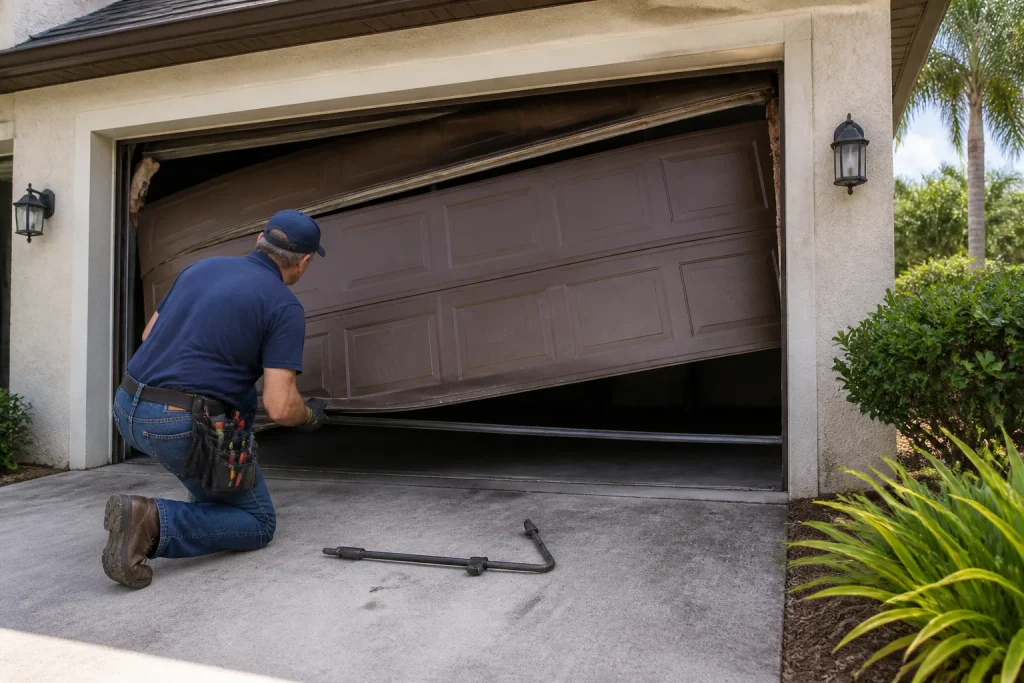
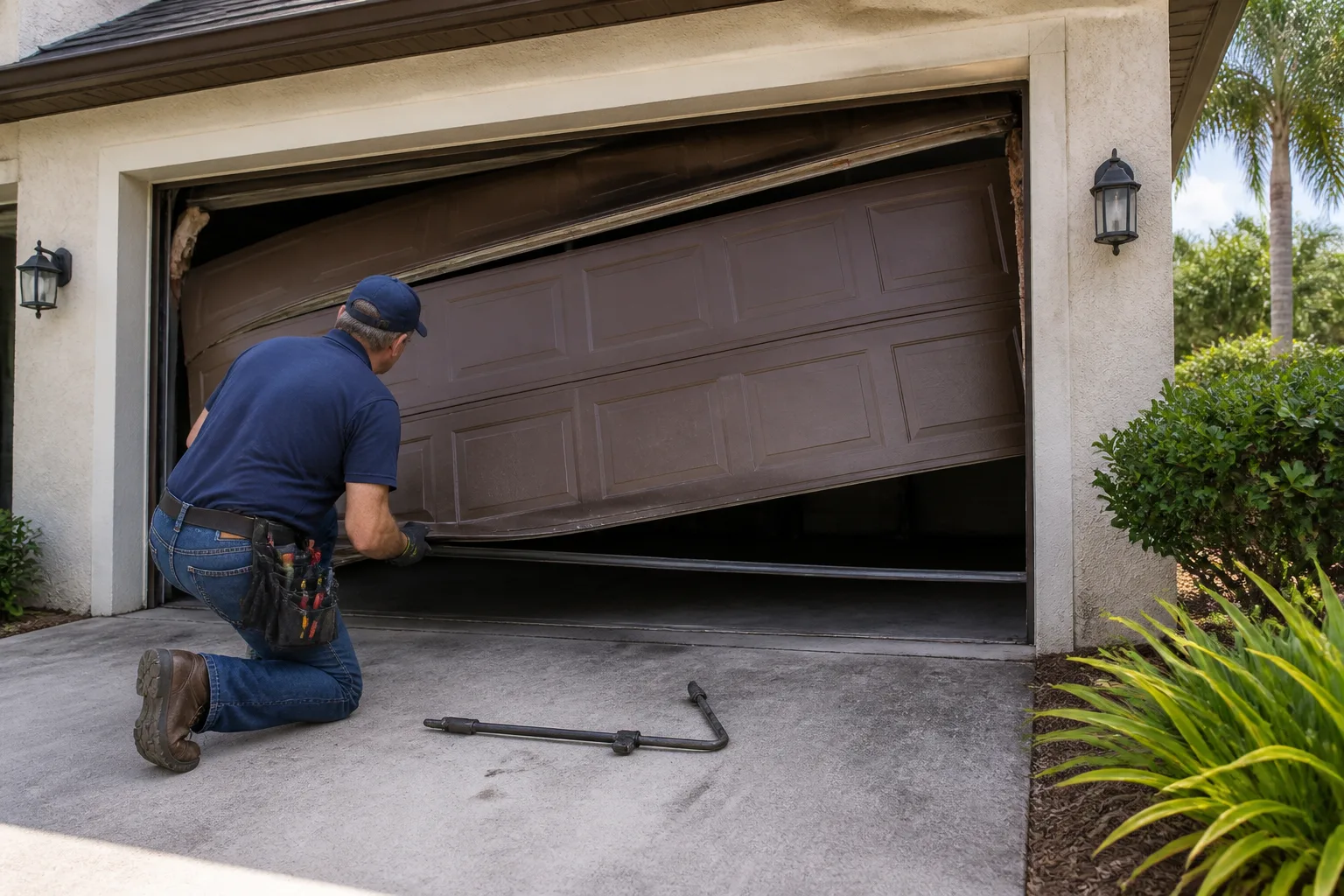
If a spring has snapped, never try to lift or operate the door by hand, and never attempt to work on a torsion spring yourself. Springs are high-tension components that can cause serious injury, and this is genuinely a job for a trained technician. Others where a pro is the right call: bent tracks the door is grinding against, a door that comes off its rollers, or an opener that keeps reversing. We also handle garage door opener repair when the door itself is fine and the trouble is electronic.
Related services in Kenwood: garage door repair for the fix, and garage door installation when replacement is the answer.
The Bottom Line
Forget age. Count the failed components. One or two compromised parts on an otherwise sound door is a repair, and repair is the right call most of the time in Kenwood’s climate. Three or more, or a three-year repair tab approaching half the cost of a new door, means replacement is the honest recommendation. Get both paths priced in writing and choose based on the numbers, not on a calendar.
If you’re in Kenwood and need help, Garage Door Repair Kenwood offers free estimates. Our technicians have up to 8 years of experience, and we’re a full-service garage door specialist, so Garage Door Repair Kenwood covers the whole life of the door. Call (844) 699-3427. When the door won’t move, one call covers it.
Frequently Asked Questions
Repair is usually the right call when only one or two components are compromised. Replace when three or more parts, especially panels and tracks, have degraded together, or when your repair spending over three years approaches half the cost of a new door. Age alone should not decide it.
Typical repairs run from about $180 to $340 for a spring replacement, with simpler fixes like rollers and adjustments costing less. A matched pair of springs costs roughly twice a single. Call (844) 699-3427 for an exact quote, estimates are free.
The written estimate sets the final price. We quote and agree the price before any work starts, so the number you approve is the number you pay. Call (844) 699-3427 for a free estimate.
The local pros we connect you with are licensed and insured as their state requires, and our technicians have up to 8 years of experience. Call (844) 699-3427 to schedule.
Written by the team at Garage Door Repair Kenwood.
Need Garage Door Help?
Call Garage Door Repair Kenwood - the local pro we connect you with is licensed and insured, here with fast after-hours help in Kenwood.
(844) 699-3427